

There’s a particular YouTube video that has been sent to me a handful of times by different friends. Since I keep seeing this and I have some thoughts based on what the Bible says (and doesn’t say), I decided to refute the claims in this video by Isaiah Saldivar, a YouTuber who is gaining notoriety within the charismatic and deliverance movements. I’m writing this blog post out of concern for those who I know and love that are still involved in this movement and to explain why I have changed my mind about it. There are a few things to note right away. My point in writing this is not to be combative, but to bring clarity on what the Word of God says about it. And there are some very muddy points that Mr. Saldivar makes in this video. Honestly, some of what he says is downright confusing once you understand what scripture has to say about this topic.
For those of you who don’t know me, I was a practicing (trained and certified) Christian deliverance minister for about 4 years. I’ve also had countless hours of ministry done for my own struggles. For those of you who do know me, I no longer believe that Christians need deliverance and I have repented privately and publicly for my past involvement in, and promotion of, this unbiblical practice. After taking a closer look at what scripture has to say, I disagree with this concept and practice, and believe there is a clear twisting of scripture that is used to endorse it. If you are a born-again Christian, you have the Holy Spirit dwelling within you. Rest assured that He will not cohabit in you with a demon. However, I know there are still numerous arguments that people present in favor of this practice, so let’s continue.
Here is the full video (only 15 minutes long) if you’re interested in watching the whole thing, but I will be providing links to clips for each of my points below as well.
Overwhelming Evidence
Early on in the video, Mr. Saldivar says there is “overwhelming evidence that Christians can have demons” and claims that we see that in scripture and experiences alike. He proceeds to name numerous subjective experiences and then rapidly fires off 15 scripture references without taking time to read them or properly exegete them and with little explanation. Let me camp on this for a minute. There is a trend that I’ve noticed at certain kinds of churches. Usually, the pastor will speak really fast throughout his sermon. He may focus more on personal experience and slow down at the most emotional points. But when he goes through scripture, he goes so fast it’s nearly impossible to look things up while he’s teaching. That is a BIG red flag and one that was raised multiple times in this video.
This is sometimes called a thought-stopping-device. It keeps people from being able to evaluate what’s being said in the moment and compare the teaching to scripture. And with how fast-paced life is today, most people don’t stop during their day to compare the things they hear to scripture. By the time someone could look something up, Mr. Saldivar is already several points down the road. If you had your Bible open during the video like I did, maybe you noticed that, too. A pastor whose interest is SOLEY in responsibly and carefully presenting the Word of God to the best of his ability without any other agenda will take his time to read verse by verse through scripture and explain the verses in context. I don’t know Isaiah Saldivar and I don’t know his reasons behind doing this, so I’m not saying he’s doing it maliciously, but malicious or not, it’s still concerning.
I won’t argue with the subjective experiences that he talks about because I don’t know the people he’s talking about, and I have no idea what their faith or mental health looks like. Plus, I’m not a pastor or a psychologist, so even if I knew them, I could only approach their experience from a biblical perspective and my advice to anyone who is hearing voices would be to seek guidance from a Christian psychologist and their pastor. I will say, however, if we use our subjective experiences as our guiderail for truth, how are we any different than the world who only have their experience to rely on? Shouldn’t we instead look to the objective Word of God to test ALL things, including our experiences? (This is precisely what I had to do when I left this practice and theology and it wasn’t pretty, so I’m not claiming to be any better than anyone else here. I’ll discuss that a little more toward the end of this blog.)
Daimonizomai
Just a couple of minutes in he focuses on demonic possession vs oppression and says there is no distinction made between the two in scripture, and the words possessed and oppressed were inserted when the Bible was translated into English for the KJV. I have a few objections to Mr. Saldivar’s statements.
His argument about the translation of the word “daimonizomai” to English in the KJV is an odd argument and may have some conflation going on. Not all English translations use the KJV as their source. In fact, most of the newer reliable translations (ESV, NASB, NIV, etc.) were translated independently of the KJV, instead using earlier Greek and Hebrew manuscripts. So, the fact that numerous English translations differentiate between demonic possession and oppression should be an indicator to us that there was good reason for distinguishing between the two ideas.
Another issue with the way he describes this word can be found right in a Bible concordance or lexicon. I searched in my NASB Strongs Concordance for daimonizomai and found the Greek word to have this definition: “to be possessed by a demon”. I also searched online using Bible Hub, Logos Bible Study software, and Blue Letter Bible. (Here are links to what I found online: BH / Logos / BLB.) Below I have a picture from my Strongs Concordance and a few screenshots from the online sources. These are great tools for all kinds of Bible study, and I highly recommend using and getting familiar with them as they can help keep us from falling into deception.

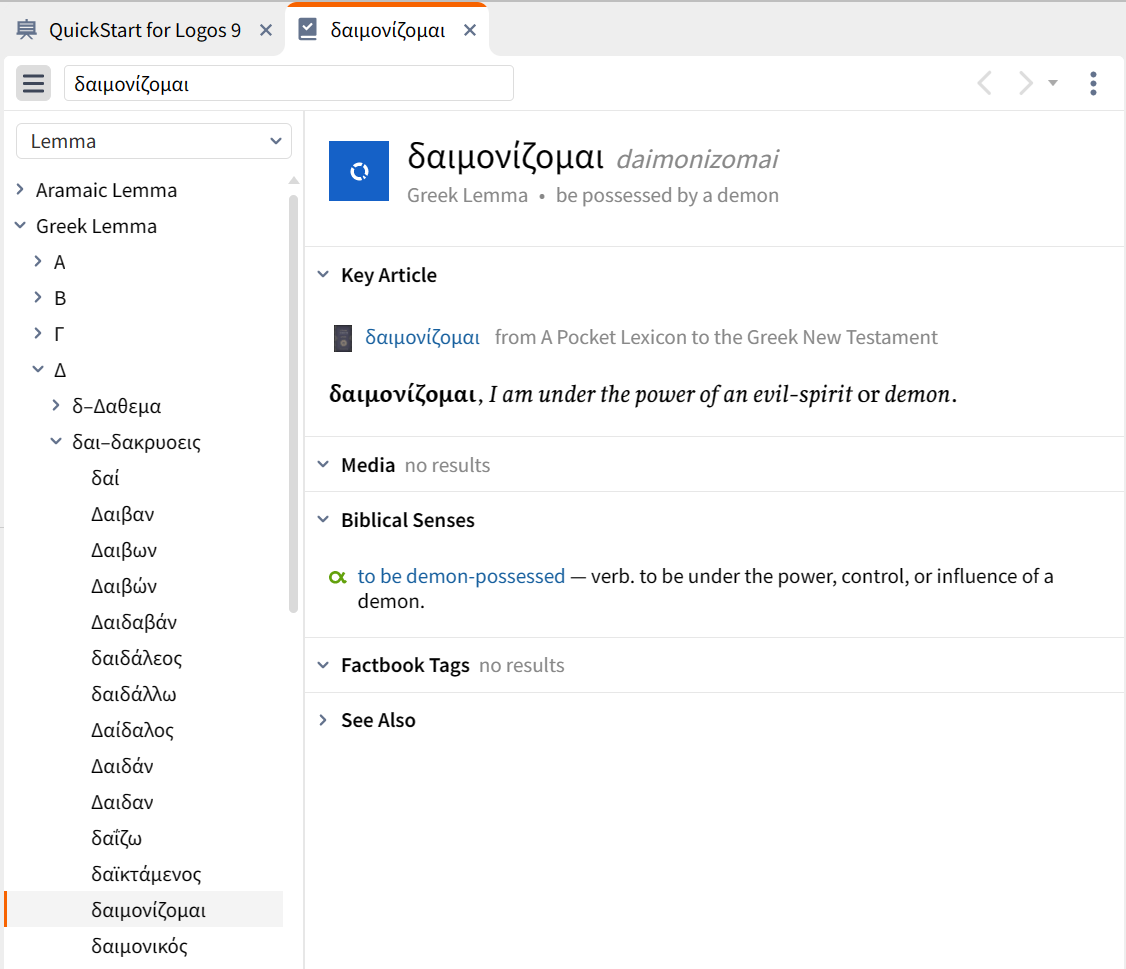

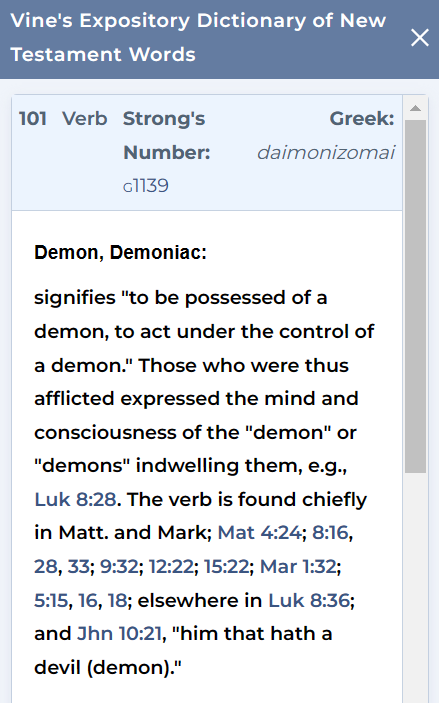
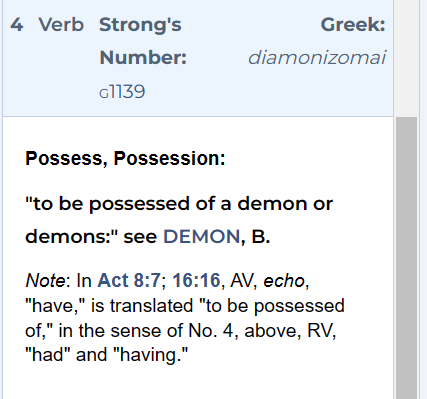
Basically, Mr. Saldivar claims that demon-possession is not a real thing and proceeds to use the word demonize instead. As he uses that word, he describes how demons can indwell, exert power and control over people, and how they must be ‘cast out’ of people. This is a functional definition of demon-possession. He’s making a distinction in the verbiage, but there is little-to-no difference in the way the words are being used.
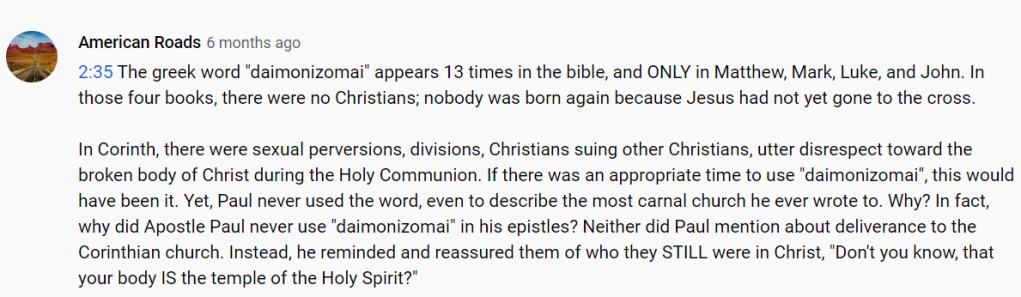
This next point was from a perfectly worded comment right on Mr. Saldivar’s YouTube video that I’m going to quote directly. YouTuber American Roads says:
2:35 The greek [sic] word ‘daimonizomai’ appears 13 times in the bible, and ONLY in Matthew, Mark, Luke, and John. In those four books, there were no Christians; nobody was born again because Jesus had not yet gone to the cross.
In Corinth, there were sexual perversions, divisions, Christians suing other Christians, utter disrespect toward the broken body of Christ during the Holy Communion. If there was an appropriate time to use ‘daimonizomai’, this would have been it. Yet, Paul never used the word, even to describe the most carnal church he ever wrote to. Why? In fact, why did Apostle Paul never use ‘daimonizomai’ in his epistles? Neither did Paul mention about deliverance to the Corinthian church. Instead, he reminded and reassured them of who they STILL were in Christ, “Don’t you know, that your body IS the temple of the Holy Spirit?”
New Testament scripture assures believers that they are permanently filled and sealed with the Holy Spirit. If we are sealed, how can a demon reside in us? (See Romans 8:9; 1 Corinthians 3:16-17 & 6:19-20; 2 Corinthians 1:21-22 & 5:5; Ephesians 1:13-14 & 4:30; John 14:16-17; 1 Peter 1:5 – please do look them up.) This is an important point because the indwelling of the Holy Spirit under the old covenant was selective and temporary. (See Numbers 27:18; 1 Samuel 10:10 & 16:12-14.)
Who will bring any charge against those whom God has chosen? It is God who justifies. Who then is the one who condemns? No one. Christ Jesus who died—more than that, who was raised to life—is at the right hand of God and is also interceding for us. Who shall separate us from the love of Christ? Shall trouble or hardship or persecution or famine or nakedness or danger or sword? As it is written: ‘For your sake we face death all day long; we are considered as sheep to be slaughtered.’ No, in all these things we are more than conquerors through him who loved us. For I am convinced that neither death nor life, NEITHER ANGELS NOR DEMONS, neither the present nor the future, nor any powers, neither height nor depth, NOR ANYTHING ELSE IN ALL CREATION, will be able to separate us from the love of God that is in Christ Jesus our Lord.
Romans 8:33-39 (emphasis mine)
Scripture References
Here are my observations about the scripture references Mr. Saldivar gives:
Mark 1:39
At the 4:20 minute mark he makes an argument that Jesus casting out demons in the synagogues is evidence that believers had demons. There are a few important things to note about the context. This is referencing synagogues, not churches. Jews, not born-again, Spirit-filled Christians. So, his own reference contradicts what he says about it because the people were not believers as we know them to be now and since the outpourings of the Spirit in Acts 2, 8 & 10 (to the Jews first, Samaritans next & finally the Gentiles).
Matthew 16:23
At the 4:33 minute mark he references the first part of the verse, but leaves the second part out, which is critical for context.
But he turned and said to Peter, “Get behind me, Satan! You are a hindrance to me. For you are not setting your mind on the things of God, but on the things of man.“
Jesus doesn’t say that Peter was indwelt or taken over by Satan. It is far more likely that He was using an expression, as evidenced by the second half of the verse, and expressing that Peter’s thinking in that moment wasn’t in line with God’s will.
John 13
At the 4:40 minute mark, Saldivar mentions Judas as an example of a believer who becomes indwelt by Satan himself. Let’s take a look at a few verses throughout the chapter for context:
During supper, when the devil had already put it into the heart of Judas Iscariot, Simon’s son, to betray him.
John 13:2
“You call me Teacher and Lord, and you are right, for so I am. If I then, your Lord and Teacher, have washed your feet, you also ought to wash one another’s feet. For I have given you an example, that you also should do just as I have done to you. Truly, truly, I say to you, a servant is not greater than his master, nor is a messenger greater than the one who sent him. If you know these things, blessed are you if you do them. I AM NOT SPEAKING OF ALL OF YOU; I KNOW WHOM I HAVE CHOSEN. But the Scripture will be fulfilled, ‘He who ate my bread has lifted his heel against me.’ I am telling you this now, before it takes place, that when it does take place you may believe that I am he. Truly, truly, I say to you, whoever receives the one I send receives me, and whoever receives me receives the one who sent me.” After saying these things, Jesus was troubled in his spirit, and testified, “Truly, truly, I say to you, one of you will betray me.”
John 13:13-21
Jesus answered, “It is he to whom I will give this morsel of bread when I have dipped it.” So when he had dipped the morsel, he gave it to Judas, the son of Simon Iscariot. Then after he had taken the morsel, Satan entered into him. Jesus said to him, “What you are going to do, do quickly.”
John 13:26-27
When read in context, to me it appears that Jesus is telling the other disciples that Judas is not a true believer as the others were. Verse 18 specifically, which I emphasized above. However, even if my interpretation of that verse in wrong, something that we have to remember is that the last supper was still prior to the death and resurrection of Jesus, and Pentecost when the Holy Spirit was sent to indwell believers.
Acts 5:3-4
Mr. Saldivar brings us to Ananias and Sapphira at about the 4:50 minute mark and says that this is a clear example of a Spirit-filled believer (after the cross) having an indwelling demon. Let’s jump right into the scripture:
But a man named Ananias, with his wife Sapphira, sold a piece of property, and with his wife’s knowledge he kept back for himself some of the proceeds and brought only a part of it and laid it at the apostles’ feet. But Peter said, “Ananias, why has Satan filled your heart to lie to the Holy Spirit and to keep back for yourself part of the proceeds of the land? While it remained unsold, did it not remain your own? And after it was sold, was it not at your disposal? Why is it that you have contrived this deed in your heart? You have not lied to man but to God.”
Although we see that Ananias and Sapphira are part of a Spirit-filled Church of believers in Acts 4, scripture does not explicitly or implicitly say that they themselves are born-again. Below is a great explanation that was sent to me by a friend.
The theological implication of Peter’s charge is that God dwells in the corporate church through individual believers filled with the Spirit. Ananias was not filled with the Spirit but with Satan. The verb filled (eplerosen) has reference to the idea of control or influence. It is the same verb used in Eph 5:18, ‘be filled with the Spirit.’ Ananias was influenced by Satan rather than by the Spirit.
The Moody Bible Commentary (ISBN: 978-0-8024-2867-7)
If, as Mr. Saldivar claimed, Ananias was already filled with the Holy Spirit, how could he then also be filled (in the same way) with Satan? This is important because I often hear the argument made that the way a Spirit-filled believer can also have a demon is because they inhabit two different areas of a person: the soul or flesh versus the spirit, because it is only a person’s spirit that is regenerated at the time when they are born again. If that’s the case, how could Ananias have been filled with the Holy Spirit and Satan in the same way? Those would have to be different kinds of indwelling. But that’s not what we see according to scripture.
1 Peter 5:8-9
At the 5:30 mark, he says that because this letter is written to the church and talks about Satan wanting to devour (and he adds demonize here) us, this is evidence that believers must be susceptible to this form of demonization. Verse 8 does tell us that the devil is prowling “around like a roaring lion looking for someone to devour“. But immediately after that, verse 9 says, “But resist him, firm in your faith, knowing that the same experiences of suffering are being accomplished by your brethren who are in the world.” Notice we are told to resist Satan and stay firm in our faith. We aren’t told that we need to cast him out or seek deliverance.
1 Timothy 4
Mr. Saldivar quickly jumps to 1 Timothy 4 (5:46) and says, “Paul warns Timothy that a time is coming where they will depart from the faith. Believers. And, they’re going to give heed to deceiving spirits and doctrines of demons. These are believers, okay, because you can’t depart from the faith if you’re not a believer. Are y’all with me tonight? So, he said they’re going to give in to deceiving spirits and doctrines of demons. These are believers that are going to do that, so Christians can give in to demons according to 1 Timothy 4.”
Verse 1 is clearly the reference in the video, but if we simply continue reading the chapter, we gain insights into what and who Paul is specifically warning about.
But the Spirit explicitly says that in later times some will fall away from the faith, paying attention to deceitful spirits and teachings of demons, by means of the hypocrisy of liars seared in their own conscience as with a branding iron, who forbid marriage and advocate abstaining from foods which God has created to be gratefully shared in by those who believe and know the truth. For everything created by God is good, and nothing is to be rejected if it is received with gratitude; for it is sanctified by means of the word of God and prayer.
1 Timothy 4:1-5
Paul is warning Timothy about false teachers who will lead people astray and instructing him on how to lead his church. Who are the false teachers influenced or controlled by? Deceiving spirits or demons. Therefore, if professing believers are not careful to stay in the word of God and prayer, they are susceptible to living out hypocrisy and having their consciences seared. The whole chapter in context is amazing and it has some great general warnings and principles that are certainly applicable today to believers and teachers alike.
2 Corinthians 11:4
At the 6:14 mark, he says, “2 Corinthians 11. Paul tells the church of Corinth ‘I fear that you would receive a different spirit other than the Holy Spirit.’ Wait a minute, Paul, why are you afraid? Christians can’t receive other spirits. But Paul says in Corinthians 11:4, ‘you’re going to receive another spirit other than the Holy Spirit.’”
Then he brings this same verse up again at the 8:00 minute mark and has this to say: “2 Corinthians 11:4 – I told you about this. [Paul] says you happily put up even if preach people preach a different Jesus, a different kind of spirit, or different kind of gospel.”
Paul is referring to the false teachers, the “super apostles”, that were infiltrating the church and preaching a different Jesus and a different gospel. Paul is warning them in 11:4 (the whole chapter, really) not to accept those teachings, or any other false gospels that may be presented to them. This isn’t about believers being indwelt by demons. Again, it’s warning not to depart from the one true faith or live wrongly by following these false teachings.
THIS LINK has a good, brief explanation of 2 Corinthians 11:4 by Pastor Mike Winger.
Matthew 12
When the unclean spirit has gone out of a person, it passes through waterless places seeking rest, but finds none. Then it says, ‘I will return to my house from which I came.’ And when it comes, it finds the house empty, swept, and put in order. Then it goes and brings with it seven other spirits more evil than itself, and they enter and dwell there, and the last state of that person is worse than the first. So also will it be with this evil generation.
Matthew 12:43-45
In this illustration, the unclean spirit leaves a person but comes back and finds the house still empty. Why is it empty? The Holy Spirit doesn’t reside there. If He was, there would not be a way for the unclean spirits to enter, otherwise it would be a divided kingdom within that person.
(6:33) – Mr. Saldivar states, “When darkness leaves you, you need something to fill you. So Jesus says when this demon goes out it creates a spiritual vacuum that if it’s not full the demons going to come back worse. This is the best picture of deliverance for believers. Why? Because the world can’t fill their spiritual house, only believers can. So why would deliverance not be for the believer?” I’m not sure where he gets that, but I would disagree completely, and I would use this chapter to back it up.
For added context pertaining to a divided kingdom, read verses 12:22-30 and see the commentary immediately below. (Note that in Matthew 12:29 Satan is the strong man in this parable and Jesus is the one who will plunder his house.)
12:22-30 A soul under Satan’s power, and led captive by him, is blind in the things of God, and dumb at the throne of grace; sees nothing, and says nothing to the purpose. Satan blinds the eyes by unbelief, and seals up the lips from prayer. The more people magnified Christ, the more desirous the Pharisees were to vilify him. It was evident that if Satan aided Jesus in casting out devils, the kingdom of hell was divided against itself; how then could it stand! And if they said that Jesus cast out devils by the prince of the devils, they could not prove that their children cast them out by any other power. There are two great interests in the world; and when unclean spirits are cast out by the Holy Spirit, in the conversion of sinners to a life of faith and obedience, the kingdom of God is come unto us. All who do not aid or rejoice in such a change are against Christ.
Matthew Henry’s Concise Commentary
Matthew 10
When we get to the 7:03 minute mark, Isaiah starts referencing Matthew chapter 10 as a reference for all believers to follow. There’s a problem with this approach to the verses listed in the video, though. They are not prescriptive for us to follow. They are descriptive of an event and instructions that happened between Jesus and the twelve disciples. And the text makes that abundantly clear.
And he called to him his twelve disciples and gave them authority over unclean spirits, to cast them out, and to heal every disease and every affliction. The names of the twelve apostles are these: first, Simon, who is called Peter, and Andrew his brother; James the son of Zebedee, and John his brother; Philip and Bartholomew; Thomas and Matthew the tax collector; James the son of Alphaeus, and Thaddaeus; Simon the Zealot, and Judas Iscariot, who betrayed him These twelve Jesus sent out, instructing them, “Go nowhere among the Gentiles and enter no town of the Samaritans, but go rather to the lost sheep of the house of Israel. And proclaim as you go, saying, ‘The kingdom of heaven is at hand.’ Heal the sick, raise the dead, cleanse lepers, cast out demons. You received without paying; give without pay.”
Matthew 10:1-8
The very first thing this passage does is clarify who Jesus was speaking to. It even goes so far as to name each of them individually. Here are the notes I took in my own Bible regarding Matthew 10:
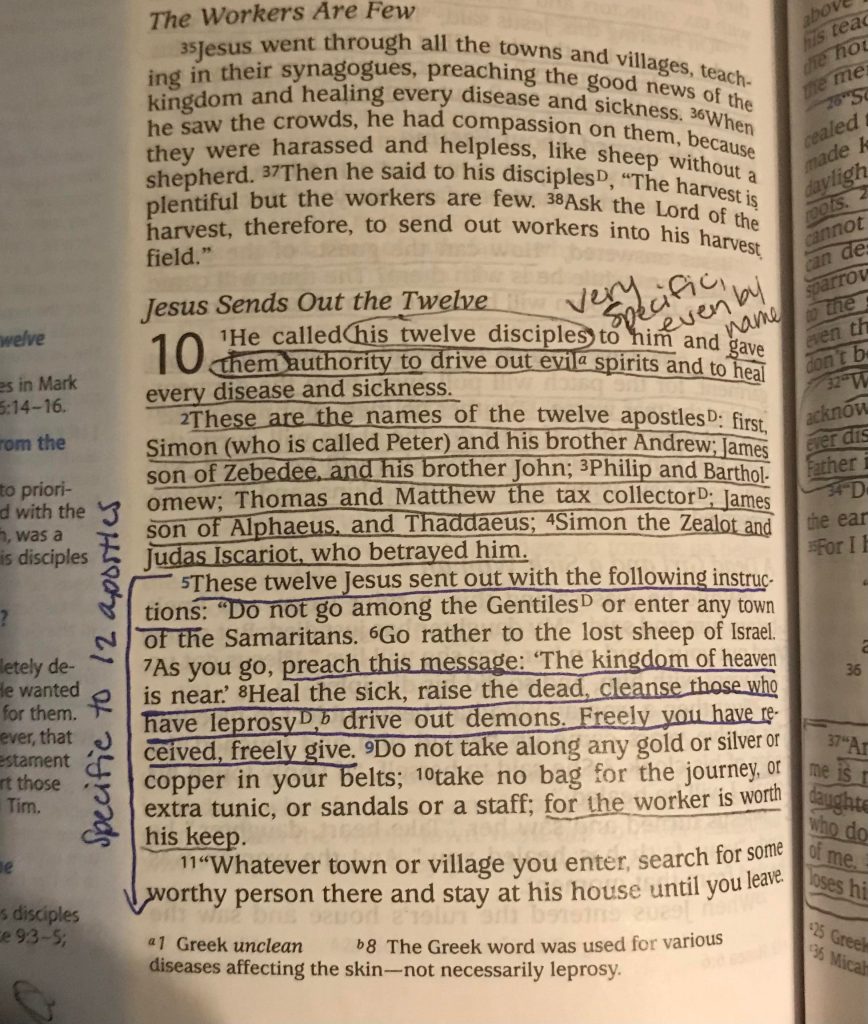
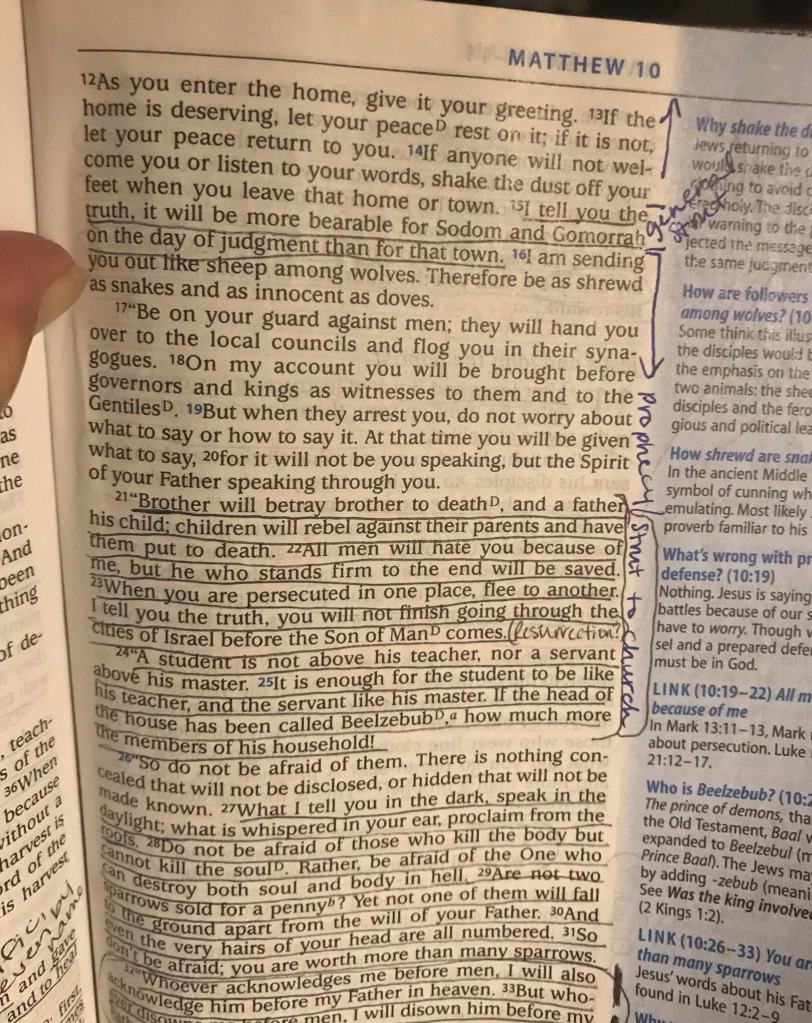
Mark 7:24-30 & Matthew 5:21
I had to rewatch this point in the video (7:43) and search scripture a little before I realized he made a mistake in the reference. It should be Matthew 15:26, which is the same story and take away as Mark 7:24. All he says about the verse is that the Bible says deliverance is the children’s bread and then quickly moves on with no further explanation. I’m honestly perplexed about this example. A reading of this verse in context would show that his implied interpretation is not accurate.
Jesus got up and went away from there to the region of Tyre. And when He had entered a house, He wanted no one to know of it; yet He could not escape notice. But after hearing of Him, a woman whose little daughter had an unclean spirit immediately came and fell at His feet. Now the woman was a Gentile, of the Syrophoenician race. And she kept asking Him to cast the demon out of her daughter. And He was saying to her, “Let the children be satisfied first, for it is not good to take the children’s bread and throw it to the dogs.” But she answered and said to Him, “Yes, Lord, but even the dogs under the table feed on the children’s crumbs.” And He said to her, “Because of this answer go; the demon has gone out of your daughter.” And going back to her home, she found the child lying on the bed, the demon having left.
Mark 7:24-30
There is nothing to indicate that the woman’s daughter is a believer in so much as one could be a believer prior to the death and resurrection of Jesus and the sending of the Holy Spirit to indwell believers. Another thing to note here is that Jesus is the one casting the demon out and there’s nothing to indicate that this is a prescription for us to follow in the context of the verses surrounding it. Rather, it seems to be a description of an event that glorifies Jesus and magnifies His deity by pointing people to who He is through His divine power. Yes, it is her faith that elicits a supernatural response from Jesus, but it’s her faith specifically in Him and recognizing who He is. If there is a prescription for us in this passage, I would venture that it’s the way the woman humbly approaches Jesus, not the action that He takes.
Luke 13
(7:48) – This is another scripture where Isaiah barely says anything, only, “a woman in the synagogue was bound by a demon.” This is a synagogue, not a church, so it’s the same issue as the Mark 1:39 reference. Plus, just like there are unbelievers in the churches today, there were likely unbelievers visiting Jewish synagogues then. Either way, they were sitting under OT Jewish teachings, not the gospel of Christ until He was there preaching it. In which case, it would make sense that people were coming to saving faith and demons were cast out of them at the same time.
Galatians 3:1-3
(7:52) – Paul is asking the Galatians who has “bewitched them”. It’s an expression. They were being seduced and enchanted by false teachings/teachers who were preaching a doctrine of salvation by works. Paul frequently uses expressions and sarcasm in his epistles, and even sharply pokes at the old pagan practices as a way of shaking the churches back to the truth of the gospel. But he’s not telling them they need deliverance in any of these. If that were the case, wouldn’t it stand to reason that it would be in scripture plainly at least one or two times?
Acts 8:5-8
(8:13) – Let’s read this passage:
Philip went down to the city of Samaria and proclaimed to them the Christ. And the crowds with one accord paid attention to what was being said by Philip, when they heard him and saw the signs that he did. For unclean spirits, crying out with a loud voice, came out of many who had them, and many who were paralyzed, or lame were healed. So, there was much joy in that city.
Acts 8:5-8
In the video when Mr. Saldivar explains these verses, he says that Philip preached, people believed, and THEN he cast out demons. But in the plain reading of these verses (I read a couple different translations) that doesn’t seem to be what’s happening at all. It would appear that as people heard and believed, the unclean spirits came out of them… possibly because the Holy Spirit entered them? And He who is in us is greater than he who is in the world (1 John 4:4). 
Next, Mr. Saldivar lists a handful of scripture references (9:25) that talk about Jesus stating that a person’s faith has made them well. He tries to use that as evidence a Christian CAN have indwelling demons, when in fact it would seem more plausible that once these people came to faith in Jesus, they were made well… and delivered. So, how about if we just go back to the original text and realize that nowhere in scripture does it say born again believers CAN have demons? Again, wouldn’t it be stated plainly at least once if it was the case?
At the 10:50 mark, Mr. Saldivar makes a claim I mentioned earlier in the post that since Christians are only renewed in spirit, demons can live in the soul (which he defines as the body, mind, will and emotions) because it’s a “different compartment” than our renewed spirit. He uses 2 Corinthians 6:14-18 as the example that people will use to combat what he is saying. I don’t think it ever would have occurred to me to use this as a proof text, although, it does make the point that believers are separate from unbelievers because we are indwelt by the Holy Spirit. However, the context of that passage doesn’t have anything to do with believers being indwelt by demons (probably one of the few things I’d agree with him on) but is rather saying that believers and unbelievers shouldn’t be bound together because believers serve the living God and unbelievers serve idols. This is all beside the point so I will bring it back around. He made the claim that Christians are compartmentalized and somehow a demon can possess us in a separate compartment than the Holy Spirit lives. 1. This seems like a very low view of the Holy Spirit (1 John 4:4 again). 2. Since he made this claim, per his own words (9:10), he holds the burden of proof to back it up with scripture. But he doesn’t.
Finally, at the 13:30 mark, Mr. Saldivar says that there is a prophetic parallel between Jesus driving out the evil money changers from the temple (Matthew 21:12) and Christians being delivered from indwelling demons because we are called the temple of God (2 Corinthians 6:16). This doesn’t work because the Greek words that are used in each of these passages mean distinctly different things and are used distinctly different ways. In Matthew 21, the word in Greek word for temple is “hieron” (#2411 in the Strong’s Concordance), and the way it is used is “a temple, either the whole building, or specifically the outer courts, open to worshippers“. In 2 Corinthians, the Greek word for temple is “naos” (#3485 in the Strong’s Concordance), and the way it is used is “a temple, a shrine, that part of the temple where God himself resides“. These are very different words that refer to different parts of the temple, and they are used differently throughout scripture.
I know this is long, but I wanted to be thorough in hopes of showing you why I came out from this deception. We are called to truth and sound doctrine over and over again in the New Testament. Hopefully I didn’t come across too snarky, but I have to admit that I do get frustrated when I hear these kinds of teachings that twist scripture and these teachers who beat people up if they disagree with them. Did you happen to notice when he called people lazy if they didn’t agree with his misinterpretation of scripture? I’ve been on the receiving end of this kind of browbeating before, and I’ve heard it from some popular pastors online. It’s gaslighting, and a form of spiritual abuse, and it’s not okay. Plus, I seem to remember a demon of laziness in deliverance ministry, so I’m not sure he can pin laziness on people, since it’s **clearly** a demon. 😏 Okay, that was sarcastic and poking fun… Sorry. In all seriousness, if you’re part of a church where you’re bullied or strong-armed into taking the pastor’s views like this, it may be time to biblically evaluate what they’re teaching.
Here’s the thing: I’m no bible scholar, and if I am able to properly exegete the scriptures, anyone can. I simply pray for wisdom before I begin reading (James 1:5) and read the surrounding verses for context. I take my time and read slowly. I check the references that are listed in scripture. And I go to commentaries from multiple Bible scholars if something is still unclear. (Multiple scholars will give multiple perspectives and help to give you a clear and balanced understanding.) These are good practices for anyone reading and studying scripture and they will help us from falling into these kinds of deceptions that were warned about all over the New Testament. I’m clearly not immune to that, as I practiced these unbiblical things myself. But I do find that in general people tend to have more clarity on the kinds of deception they’ve practiced after repenting of them and determining to study the truth instead.
And we know that for those who love God all things work together for good, for those who are called according to his purpose.
Romans 8:28
I was recently asked why I thought that deliverance ministry for Christians and the concept of indwelling demons was taught by so many, and why people believe they need deliverance as Christians. I think a couple of different things are probably most common. These were likely what I was witnessing most often when I ministered to people. 1. Someone is a self-professing believer but has never actually heard or understood the full gospel message of law and the grace of the cross and the resurrection, so it’s possible they aren’t truly in the faith. They need the gospel, not deliverance ministry. Or, 2. They have major sin issues that they don’t want to crucify or put in the work of accountability, so they have itching ears when they hear about the concept of deliverance ministry for Christians.
That was my issue. ‘I can blame my sins on something else and there’s a quick fix for them?? I’m taking that route!’  That sounds horrible, and it wasn’t a conscious thought like that, but it’s the truth of where I was, and I think probably where a lot of other Christians are, sadly. There may have been a few people who were actually outwardly afflicted by the demonic when I was practicing these things. But biblical prayer and petitioning God is the answer, not deliverance ministry.
We have freedom in Christ. We are not burdened with the need to cast out indwelling demons from among us. There is no freedom in that lifestyle. I lived it. It’s oppressive and burdensome to always be looking for the generational curses or word curses or negative agreements or whatever else may have opened the door to a demon. Our life is to be lived in faith, hope and love to the glory of God for the good gifts He’s already given us.
It is for freedom that Christ has set us free. Stand firm, then, and do not be encumbered once more by a yoke of slavery.
Galatians 5:1
Blessings,
Robin 💜


